Introduction to Transcription Factors in Molecular Biology
Transcription factors (TFs) are DNA-binding proteins that regulate gene expression by interacting with specific promoter or enhancer sequences. They act as molecular switches that translate intracellular and extracellular signals into transcriptional responses, thereby controlling cell growth, differentiation, metabolism, and stress responses. Comprehensive educational introductions to transcription factor biology are available from https://www.ncbi.nlm.nih.gov/books/NBK26873/ and https://www.genome.gov/genetics-glossary/Transcription-Factor.
Transcription Factor Activity Assay Kits provide standardized, reproducible laboratory methods to measure the functional activity of transcription factors rather than simply their expression levels. These kits are designed exclusively for research use and are widely applied in cell biology, signal transduction, oncology, immunology, and systems biology research.
Biological Basis of Transcription Factor Activity
DNA Binding and Transcriptional Regulation
Transcription factors regulate gene expression by binding to specific DNA motifs and recruiting co-regulators that either activate or repress transcription. Educational resources from https://www.ncbi.nlm.nih.gov/pmc/articles/PMC3312678/ and https://www.ncbi.nlm.nih.gov/books/NBK6360/ explain how TF–DNA interactions determine transcriptional outcomes.
Transcription Factor Activity Assay Kits enable researchers to:
-
Measure sequence-specific DNA binding activity
-
Compare transcription factor activation across conditions
-
Study signal-induced nuclear translocation
-
Quantify functional TF responses downstream of signaling pathways

Signal Transduction and Transcription Factor Activation
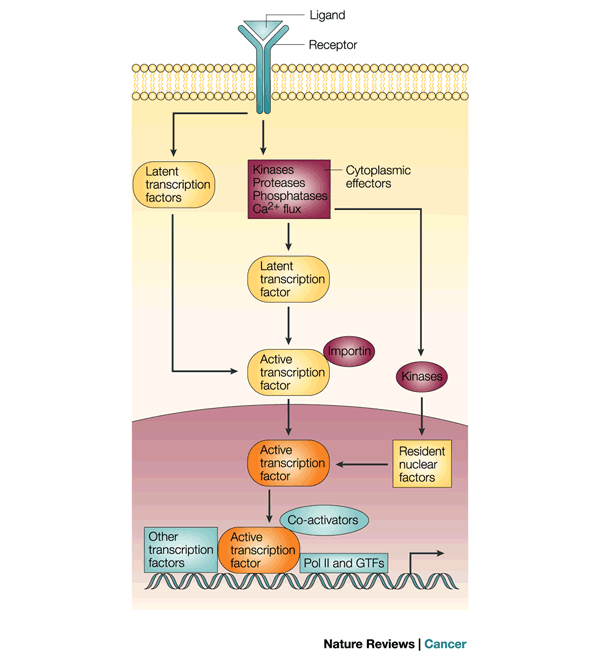
Many transcription factors are regulated by phosphorylation, ligand binding, or redox changes triggered by signaling cascades. Classic examples include stress-responsive, inflammatory, and metabolic transcription factors. Academic explanations of signaling-dependent TF activation are available at https://www.ncbi.nlm.nih.gov/books/NBK26813/ and https://www.ncbi.nlm.nih.gov/pmc/articles/PMC5452155/.
Assay kits support:
-
Analysis of pathway-dependent TF activation
-
Time-course studies of transcriptional responses
-
Functional assessment of upstream signaling events
-
Comparative evaluation of cellular responses to stimuli
Types of Transcription Factor Activity Assays
DNA Binding-Based Assays
DNA binding assays quantify the ability of transcription factors to interact with their cognate response elements. Educational assay overviews are available from https://www.ncbi.nlm.nih.gov/pmc/articles/PMC3372118/ and https://www.ncbi.nlm.nih.gov/books/NBK556084/.
These assay kits enable:
-
Quantitative measurement of TF–DNA interactions
-
High specificity for defined response elements
-
Parallel analysis of multiple transcription factors
-
Standardized workflows for nuclear extracts
Reporter Gene Assays
Reporter assays measure transcription factor activity through downstream gene expression driven by TF-responsive elements. Foundational explanations of reporter gene systems can be found at https://www.ncbi.nlm.nih.gov/books/NBK26900/ and https://www.ncbi.nlm.nih.gov/pmc/articles/PMC4841512/.
Transcription Factor Activity Assay Kits support:
-
Sensitive detection of transcriptional activation
-
Functional readouts of TF signaling
-
Comparative analysis across treatments
-
High-throughput screening applications
Nuclear Translocation and Activation Assays
Some transcription factors are activated through regulated nuclear import. Educational discussions of nuclear signaling can be found at https://www.ncbi.nlm.nih.gov/books/NBK26830/ and https://www.genome.gov/genetics-glossary/Nucleus.
These assays allow:
-
Measurement of cytoplasmic-to-nuclear translocation
-
Functional correlation between localization and activity
-
Integration with signaling pathway studies
Laboratory Applications of Transcription Factor Activity Assay Kits

Transcription factors play central roles in cell proliferation, differentiation, and stress adaptation. Research-focused TF activity assays enable mechanistic studies of transcriptional regulation in experimental cancer models, as described in educational resources from https://www.cancer.gov/research/areas/cancer-biology and https://www.ncbi.nlm.nih.gov/pmc/articles/PMC5525181/.
Immunology and Inflammation Research
Immune responses rely on tightly regulated transcriptional programs. Academic and government-supported discussions at https://www.niaid.nih.gov/research and https://www.ncbi.nlm.nih.gov/pmc/articles/PMC5611913/ highlight how transcription factor activity drives immune cell activation and differentiation.
Transcription Factor Activity Assay Kits support:
-
Analysis of immune signaling pathways
-
Quantification of stimulus-dependent TF activation
-
Comparative immune response studies
Stem Cell and Developmental Biology
Cell fate decisions are controlled by dynamic transcription factor networks. Educational material from https://stemcells.nih.gov/info/scireport/pages/chapter-2.aspx and https://www.ncbi.nlm.nih.gov/books/NBK26842/ explains how transcriptional regulation governs pluripotency and differentiation.
Assay kits enable:
-
Monitoring TF-driven differentiation pathways
-
Comparative analysis of lineage commitment
-
Functional validation of regulatory networks
Toxicology and Environmental Response Studies
Environmental stressors often activate transcription factors involved in detoxification and stress responses. Government-supported research at https://www.epa.gov/sciencematters and https://www.niehs.nih.gov/health/topics/science/toxicology/index.cfm emphasizes the role of transcriptional assays in environmental health research.
Drug Discovery and Mechanistic Screening
Transcription factor activity assays are widely used in early-stage discovery research to study pathway modulation. Educational overviews of screening strategies are available at https://www.ncbi.nlm.nih.gov/books/NBK27994/ and https://www.niehs.nih.gov/health/topics/science/tox21/index.cfm.
These kits support:
-
Functional screening of pathway modulators
-
Dose-response and time-course studies
-
Mechanistic validation of cellular signaling
Advantages of Transcription Factor Activity Assay Kits
From a laboratory workflow perspective, these kits offer:
-
Optimized and validated reagents
-
High specificity for functional TF activity
-
Compatibility with multiple cell types and extracts
-
Scalability for exploratory and high-throughput research
These advantages align with best research practices promoted by initiatives such as https://oir.nih.gov/sourcebook/ethical-conduct/responsible-conduct-research-training.
Integration with Multi-Omics and Systems Biology
Transcription Factor Activity Assay Kits are increasingly integrated with transcriptomics, epigenomics, and proteomics to provide a systems-level understanding of gene regulation. Government-funded initiatives such as https://www.genome.gov/Funded-Programs-Projects and https://www.ncbi.nlm.nih.gov/guide/cellbiology/ emphasize the importance of functional transcriptional data in modern biology.
Conclusion
Transcription Factor Activity Assay Kits are essential tools for decoding how signaling pathways regulate gene expression. By enabling direct, functional measurement of transcription factor activity, these kits help laboratories translate complex regulatory networks into reproducible experimental data.
Designed strictly for research use, Transcription Factor Activity Assay Kits support discovery-driven science across cell biology, immunology, cancer research, toxicology, and systems biology—fully aligned with the educational standards, methodologies, and best practices established by leading .edu and .gov research institutions worldwide.